About Hällristningar på Kinnekulle
At Flyhov in Götene municipality, one of Sweden's most fascinating historical treasures awaits. Here, on sandstone slabs polished smooth by the inland ice thousands of years ago, lies one of the country's richest collections of rock carvings. With over 500 figures and signs, the site offers a unique and atmospheric insight into the world of the Bronze Age – a time of rites, journeys, and ancient creative power.
A 3,000-year-old meeting place
Wandering among the rock carvings at Flyhov is like stepping directly into another era. The silent images convey a strong sense of reverence for the people who lived here over 3,000 years ago. It is likely that the slabs served as a ritual meeting place or a means of communication where myths were immortalised and ceremonies performed. Today, Flyhov is a protected heritage site that reminds us of the timeless human need to express ourselves through art and symbolism.
Traces of the Ice Age
Nature itself laid the foundation for this artwork. The slabs consist of sandstone bearing clear traces of the enormous power of the inland ice, with long glacial grooves and polished depressions. It was likely the smooth, inviting rock that led the people of the Bronze Age to choose this specific location for their carvings. Because the images remained protected under soil and peat until the end of the 19th century, many are unusually well-preserved, with sharp edges where the marks of ancient tools can still be seen today.
Mysterious motifs and symbols
The visual world at Flyhov is rich and varied. Visitors are met by symbolic motif groups that tell of the passage of life and the Bronze Age worldview:
- Ships and canoes: Despite the site not being near the sea, ships are one of the most common motifs. These beautiful vessels, often with animal heads on the prows, may have symbolised long-distance trade journeys to Central Europe or served as ritual vessels for the sun.
- Footprints and wheel crosses: These abstract signs are found across the entire rock and are often interpreted as symbols for deities or sacred movements.
- Animals and nature: Horses, deer, and even horned serpents wind across the stone, testifying to the significance of the animal kingdom in the beliefs of the time.
The Axe God and the Bird-headed Men
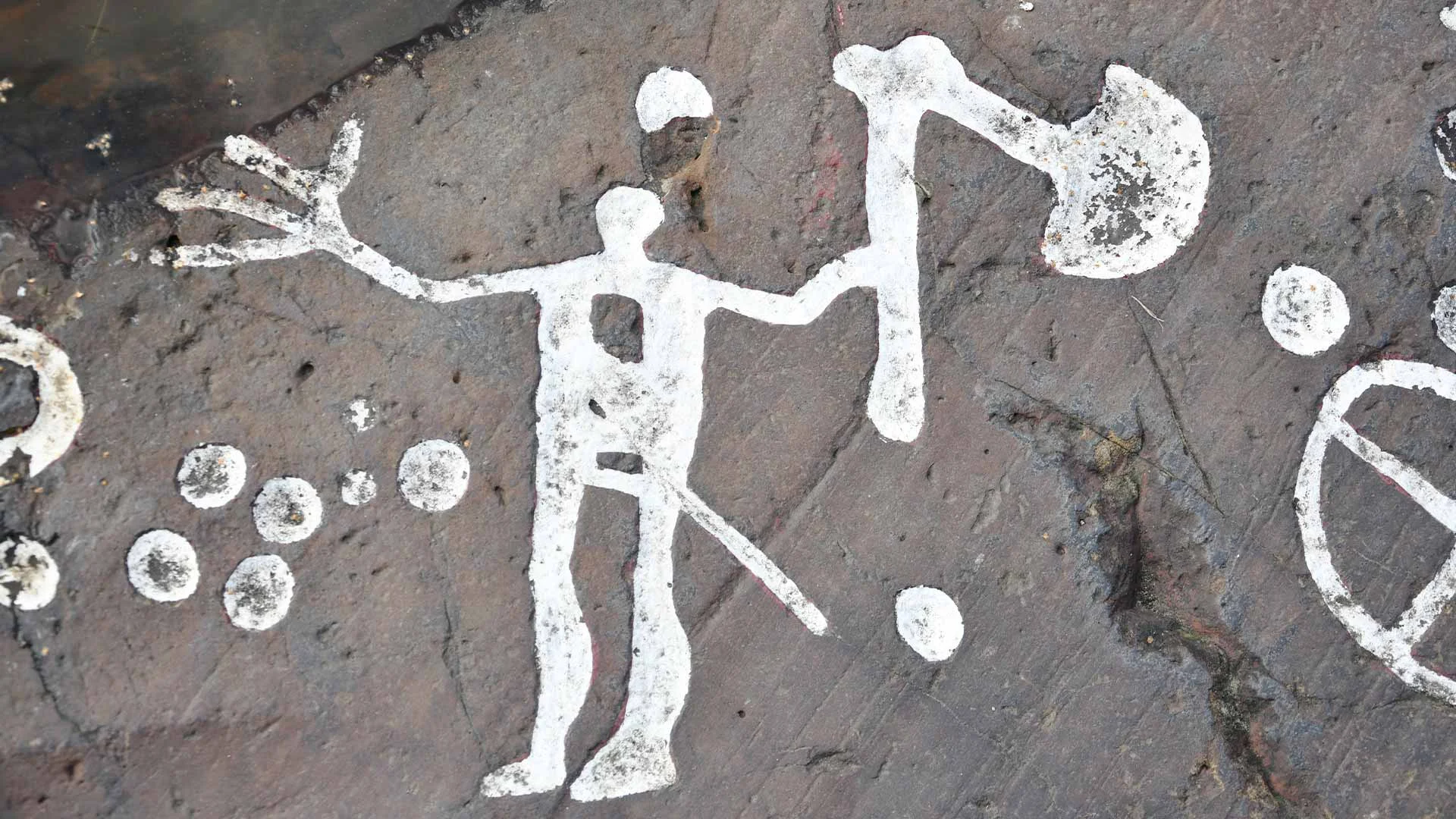
Among the most famous figures is the "Axe God", a powerful figure armed with an axe and sword. His characteristic axe allows researchers to date the carving to the middle of the Bronze Age, around 1000 BC.
Another intriguing detail is the figures with bird heads. These men, depicted in profile with beaks and swords, often stand alone and are believed to have represented leaders of important cults or rituals.
Visit Flyhov
To make the ancient images easier to see, many have been carefully filled in with red paint, while others have been left entirely natural to show how they looked when first discovered. A visit to Flyhov is a perfect day trip for those staying at Valle Camping who wish to combine beautiful nature with a moving encounter with history. Here, you get the chance to see the world through the eyes of Bronze Age people, right in the heart of the Västergötland landscape.
Good to know
On the map
The line shows a suggested driving route from Valle Camping.