About Biskopsborgen Husaby
The Biskopsborg (Bishop’s Castle) in Husaby is a historic site that played a vital role in the Christian history of Sweden, and particularly Västergötland. Originally the bishop's residence, the castle is located in Husaby near the spring where Sweden's first Christian king, Olof Skötkonung, was traditionally baptised in the early 11th century. Throughout the Middle Ages, Husaby remained an important episcopal seat, even though Skara served as the diocesan capital with its cathedral. The site was likely inhabited as early as the 13th century or before, though the original manor may have stood closer to the church.
Bishop Brynolf
The ruins of the Biskopsborg seen today were constructed in five stages, beginning around 1480, although some researchers suggest construction started before the era of Bishop Brynolf, in the early 15th century. Regardless, it was during the tenure of Bishop Brynolf Gerlaksson (who served in Skara between 1478 and 1505) that the castle was significantly expanded and reinforced.
The castle served not only as the bishop's residence but also as an administrative centre and a symbol of the church's power and influence in the region.
15-metre high stone wall
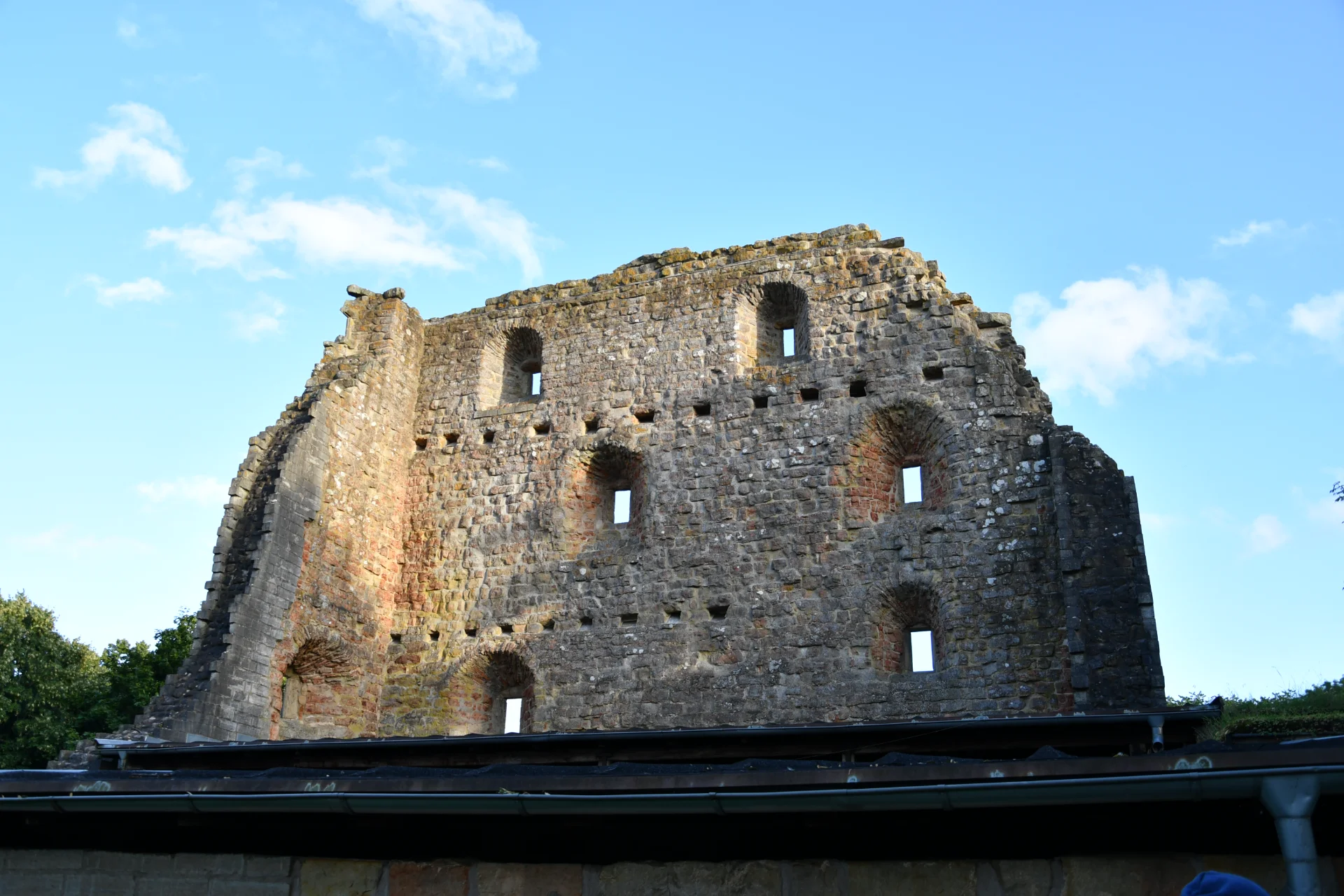
The oldest part of the castle is the square stone house, whose south wall still rises over fifteen metres high today. It originally consisted of four floors, featuring three rooms and a prison on the ground floor, while the upper floors contained living quarters and a grand hall. The ground floor remains well-preserved.
Built in stages
The castle soon evolved from a simple stone house into a fortified stronghold. A second construction phase included a southwest extension, likely for defensive purposes. During the third phase, additional structures were added to the west, including thick walls surrounding a well to secure the water supply. A surrounding curtain wall, up to one and a half metres thick and preserved to a height of two metres, was also added. Further buildings followed, including a half-timbered annexe that served both economic and defensive purposes, complete with gun ports and a flanking tower.
Central heating
One of the castle's most interesting features was its central heating system, using a hot-air furnace known as a hypocaust. Heat from the furnace was channeled through ducts in the walls to warm the bishop's state room—a technique also utilised in other medieval buildings in Sweden.
THE REFORMATION MARKED THE END
Following the Reformation in the 16th century, the castle lost its original function. In 1527, the church’s property in Husaby was confiscated by the Crown as part of the Reformation, and the Biskopsborg was subsequently destroyed. Over time, the structure fell into disrepair and was eventually demolished.
EXCAVATIONS
It wasn't until the early 1960s that archaeological excavations began, revealing the castle ruins. These excavations provided valuable insight into the castle's scale and construction, as well as its role in the region's religious and political history.
Visiting the ruin
Sankt Sigfrid’s Spring and the Biskopsborg are easily accessible and located just a few kilometres west of Götene. Parking is available at Husaby Church, and the Biskopsborg is a short walk away.
Husaby Biskopsborg is situated on private land, and visitors are asked to show consideration for local residents. Today, the Biskopsborg in Husaby is a fascinating ruin and an important historical site that attracts both history enthusiasts and tourists. The site offers a unique glimpse into Sweden’s early Christian history and medieval architecture, continuing to be an important subject of study for researchers interested in the ecclesiastical and cultural development of the Nordic Middle Ages.
Good to know
On the map
The line shows a suggested driving route from Valle Camping.